Agricultural Lime for Lawns: A Homeowner's Guide
You fertilize. You water. You mow at a sensible height. But the lawn still looks thin, pale, or patchy.
That usually sends homeowners shopping for more fertilizer. In a lot of yards, that’s the wrong next move. The grass may already have access to nutrients on paper, but the soil pH is keeping those nutrients out of reach.
That’s where agricultural lime for lawns comes in. Not as a cure-all, and not as something to throw down “just in case,” but as a targeted fix when a soil test says your pH is too low.
If you’ve got a soil test in hand and you’re not sure what to do with the pH numbers, this guide is the bridge between the report and your spreader.
Table of Contents
- Is Your Lawn Struggling? The Answer Might Be Your Soil pH
- What Agricultural Lime Does for Your Lawn
- Interpreting Your Soil Test for Lime Needs
- Choosing the Right Type of Agricultural Lime
- Your Lime Application Action Plan
- Common Mistakes When Using Lime on Your Lawn
- Frequently Asked Questions About Liming Lawns
Is Your Lawn Struggling? The Answer Might Be Your Soil pH
A common lawn problem looks like a fertilizer problem but isn’t one.
The homeowner sees yellowing grass, weak growth, and weeds filling thin spots. They feed the lawn again. Maybe they add iron. Maybe they water more. The lawn improves a little, then stalls again. That’s often what happens when the issue is acidic soil.
Soil pH is a measure of how acidic or alkaline your soil is. For lawns, pH acts like a gatekeeper. If it’s too low, your grass can’t make good use of nutrients that are already in the soil or already applied through fertilizer.
What this looks like in a real yard
You might notice:
- Color problems that don’t fully respond to fertilizer
- Slow recovery after heat, mowing stress, or foot traffic
- Patchy density even when watering is fairly consistent
- Weed pressure in spots where turf should be thickening
None of those symptoms proves you need lime. They only tell you something is off below the surface.
A lawn can look hungry even when the real problem is that the soil won’t let the grass “eat.”
What to do next
Before you buy anything, pull out your soil test and find the soil pH number.
That number tells you whether lime belongs in the plan at all. If your pH is low, liming can be a foundational fix. If your pH is already fine, lime won’t help and can make things worse.
What Agricultural Lime Does for Your Lawn
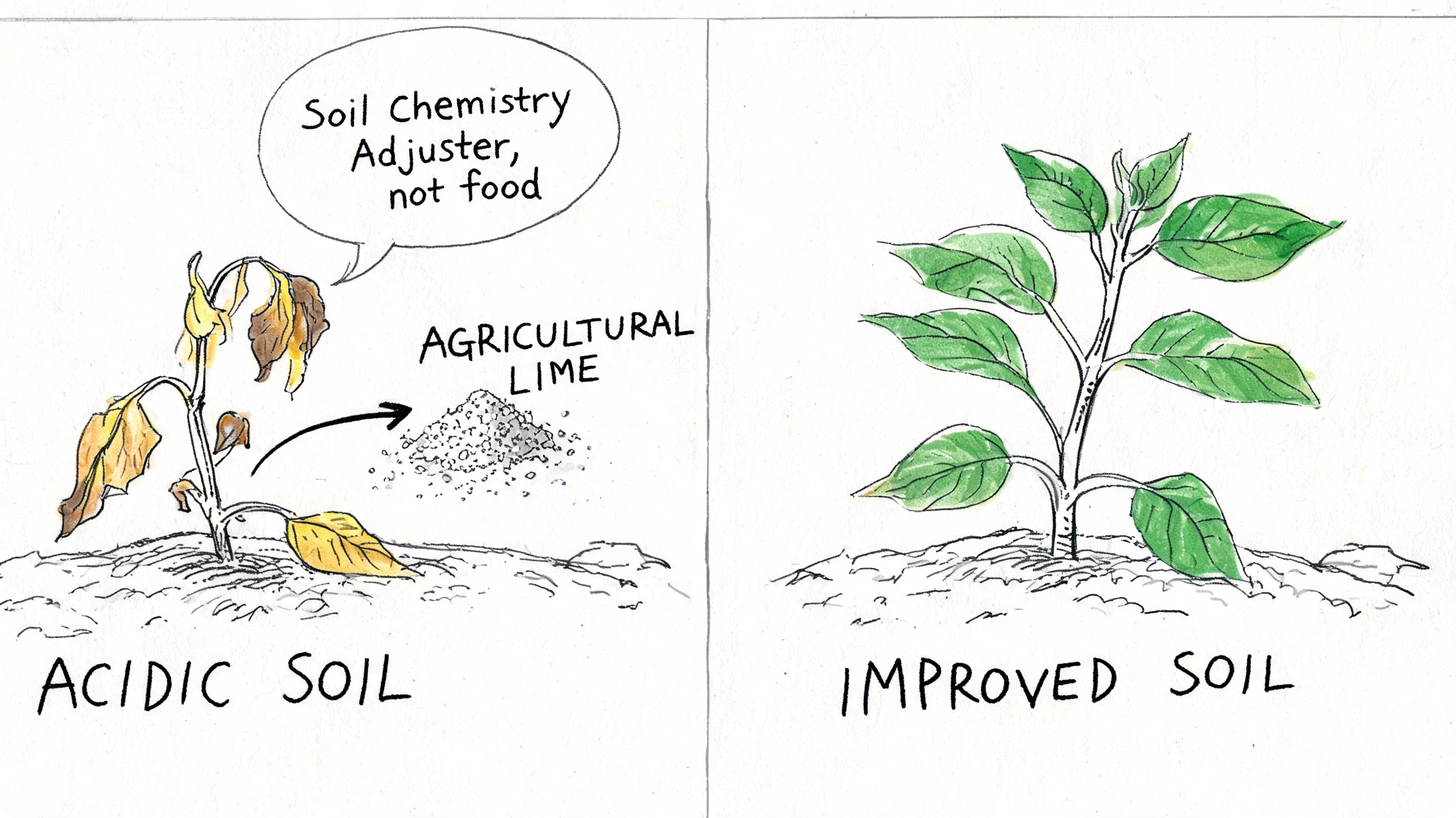
Agricultural lime changes the soil. It does not directly feed the grass.
That distinction matters because many homeowners treat lime like a booster product. It isn’t. Its job is to correct acidic soil so your lawn can use nutrients more effectively.
Lime is not fertilizer
Think of your soil like a pantry.
Fertilizer puts food in the pantry. Low pH locks the door. Agricultural lime for lawns is the key that helps open it again.
Agricultural lime is mainly pulverized calcium carbonate. It neutralizes soil acidity by reacting with hydrogen ions and raising soil pH. That matters because low pH can lock up nutrients your turf needs. In cool-season grasses, phosphorus uptake can be reduced by up to 50%, and potassium availability drops significantly below pH 5.5, as described in this overview of agricultural lime.
Why acidic soil causes trouble
When pH is too low, several things work against your lawn at the same time.
- Phosphorus gets tied up. That hurts rooting and establishment.
- Potassium becomes harder to access. That weakens stress tolerance.
- Nitrogen becomes less efficient. You can apply fertilizer and still get a poor response.
That’s why liming often improves the performance of products you’re already using. It fixes the soil condition that was holding the lawn back.
Practical rule: Lime makes sense when a soil test says the pH is low. It does not make sense as a routine annual habit for every lawn.
A good liming decision always starts with test data, not lawn folklore.
Interpreting Your Soil Test for Lime Needs
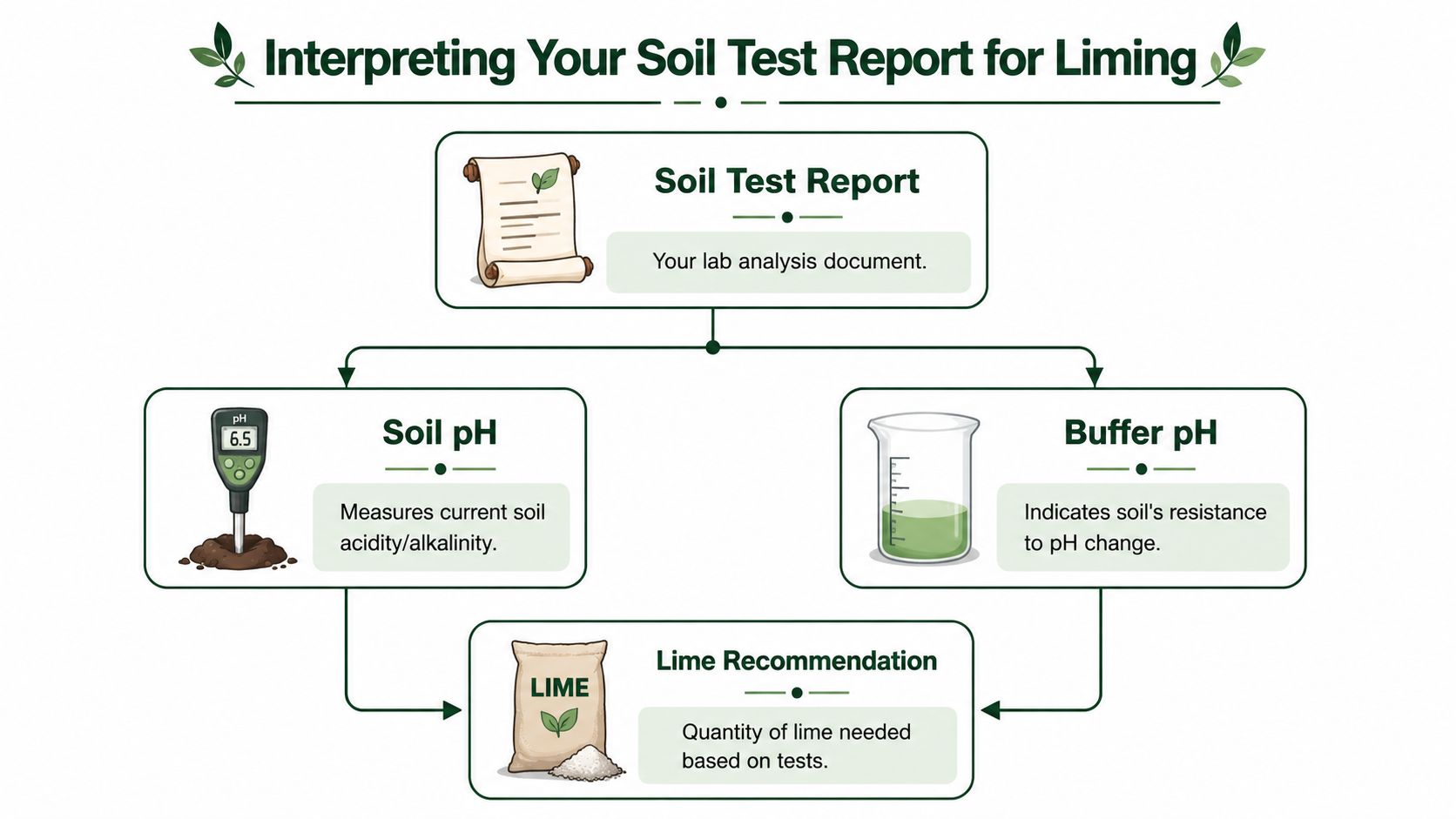
Most homeowners need to focus on two lines in the report. Not ten. Not every trace element. Just the two values that control the liming decision.
The two numbers that matter most
Soil pH tells you the current acidity level.
Buffer pH tells you how resistant the soil is to change. In plain English, it helps estimate how much lime it takes to move the pH upward. A lighter soil usually shifts more easily than a heavier one, while soils with more buffering need more product to get the same change.
If your lab report already gives a lime recommendation per 1,000 square feet, use that number. That’s the cleanest path.
If you’re still looking for a lab that gives useful lawn data, start with soil testing labs for lawn analysis.
How to make the call
For most turf, the useful range is generally around pH 5.8 to 7.2. If your lawn is below that range, lime may be appropriate. If your report shows the pH is already fine, skip it.
There’s also a money angle here. Correcting soil pH with lime based on soil test recommendations often returns $5 to $10 for every dollar spent, and the benefit is treated as a 5 to 10-year investment, according to Michigan State guidance on liming soils.
Here’s the decision framework I’d use:
- Find the soil pH. This tells you whether the lawn is acidic enough to consider lime.
- Check the lab recommendation. If the lab gives a lime rate, use it instead of guessing.
- Look for buffer pH or lime requirement. That explains why one lawn needs a light correction and another needs more.
- Match the recommendation to your product. Product quality affects the actual amount you’ll spread.
A practical example
If your soil test shows a pH below the preferred range for turf and the lab recommends lime per 1,000 square feet, your next step is not to hunt for a generic online rate. Your next step is to convert that lab rate to your yard size and then match it to the product’s label.
If your pH is already in range, your action is even simpler: don’t lime.
That one decision prevents a lot of wasted product and a lot of disappointment.
Choosing the Right Type of Agricultural Lime
Once the soil test indicates a need for lime, the next question is what to buy. Homeowners often get sidetracked by marketing at this point, rather than focusing on the crucial aspects.
Pelletized or pulverized
For most homeowners, pelletized agricultural limestone is the practical choice.
It spreads cleanly through a rotary or drop spreader and avoids the dust problem that comes with loose pulverized products. Pelletized products also fit better with how DIY lawn care happens, which is usually one person, one spreader, and limited patience for messy materials.
The product’s effectiveness depends in part on its Calcium Carbonate Equivalent, or CCE. That number tells you how strong the liming material is compared with pure calcium carbonate. For pelletized products, CCE commonly ranges from 70% to 95%, which directly affects how much product you need to hit your pH target, as noted in this ag lime material guide.
Calcitic or dolomitic
This is the part that should come straight from your soil test.
If your magnesium is low, choose dolomitic lime. It supplies both calcium and magnesium.
If magnesium is already adequate, calcitic lime is usually the cleaner choice because it focuses on calcium without adding extra magnesium your soil may not need.
| Feature | Calcitic Lime | Dolomitic Lime |
|---|---|---|
| Main makeup | Mostly calcium carbonate | Calcium and magnesium carbonate |
| Best use | When magnesium is already sufficient | When soil test shows low magnesium |
| Soil test tie-in | Supports pH correction without adding much magnesium | Corrects pH and adds magnesium at the same time |
| Homeowner takeaway | Good default if magnesium is fine | Better fit when magnesium is low |
Buy lime based on the soil test, not the bag’s marketing claims.
If you want a faster pH adjustment, higher CCE material is generally preferable, and dolomitic lime is often the better fit when magnesium is part of the problem.
Your Lime Application Action Plan
The soil test turns into a real plan at this stage.
A good lime plan answers four things clearly: what to apply, how much to apply, when to apply it, and what happens next in the rest of your lawn schedule.
How much lime to buy
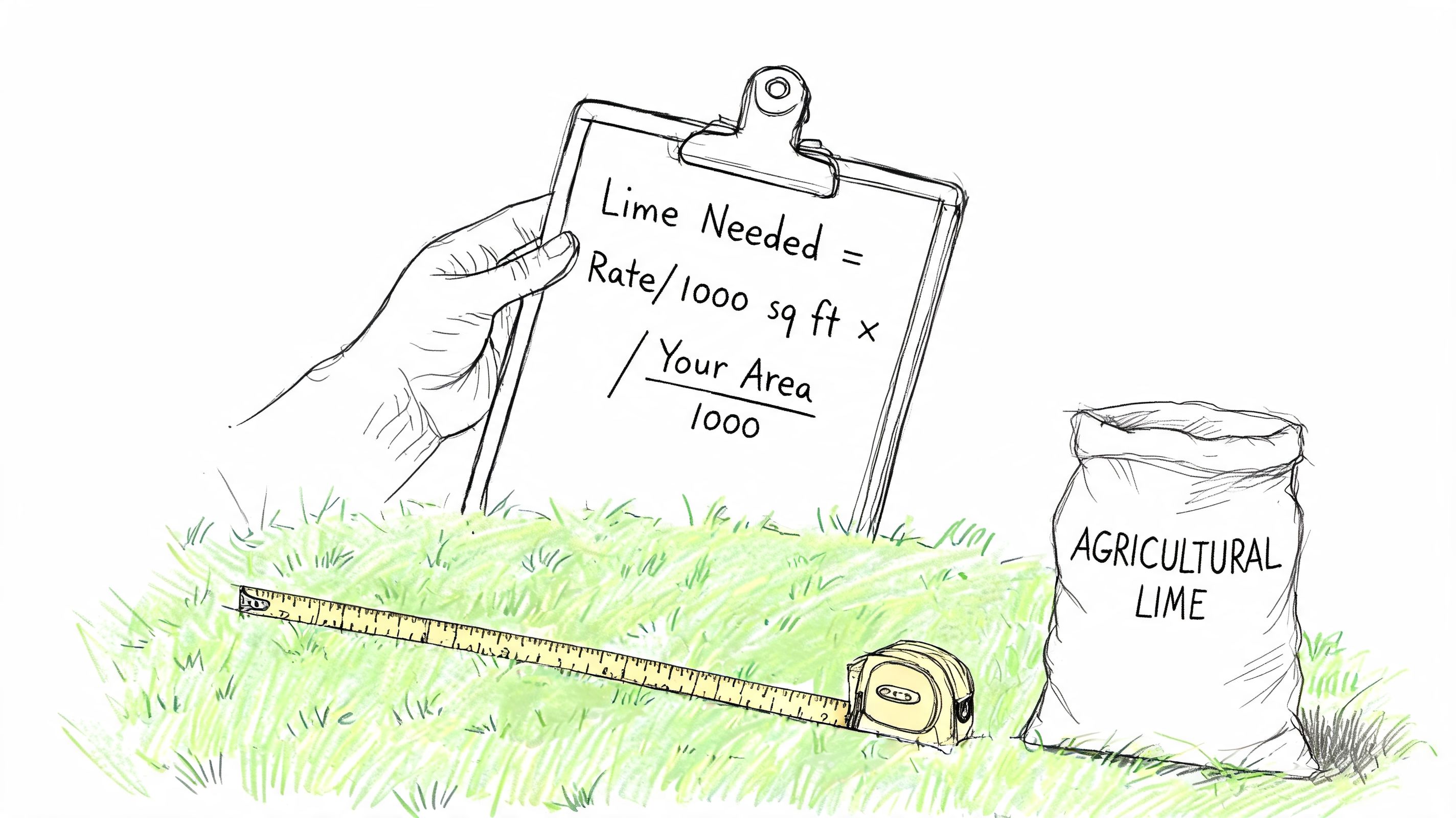
Use this simple formula:
Recommended rate per 1,000 sq ft × (lawn size ÷ 1,000) = total pounds of lime needed
Here’s a real example using your lab’s format.
If your soil test recommends X pounds per 1,000 sq ft and your lawn is Y thousand sq ft, multiply those numbers to get the total pounds needed for the full application. Then check the bag label and adjust for the product’s CCE if the label or your plan calls for it.
A few practical steps make this easier:
- Measure the lawn first. Don’t estimate if you can avoid it.
- Use the lab rate, not a generic bag rate. Bags are broad suggestions. Your soil test is specific to your yard.
- Calibrate your spreader. Even a good product is useless if you throw it down unevenly.
If you want a tool-based way to turn pH and square footage into a season plan, MySoilPlan lawn guides and scheduling tools can help you line that up with the rest of your care calendar.
When and how to apply it
Fall is the timing I’d pick most years.
Lime is slow. It needs time, moisture, and soil contact. Pennington notes that raising pH from 5.5 to 6.2 improves nitrogen availability and that lime works best as a foundational treatment before future fertilizer applications, with fall being a good timing window for the next season’s nutrient plan in this lawn lime timing guide.
Apply it with a rotary or drop spreader, then water it in lightly so it can start moving into the soil.
Use this sequence:
- Mow if needed first. You want easy spreader access across the surface.
- Apply the lime evenly. Straight passes are better than random walking patterns.
- Water it in. A light watering helps settle the material and start the reaction.
- Resume normal lawn care. Don’t expect a dramatic color change next week.
How often to apply
For a homeowner schedule, once per year is usually the most practical rhythm when a test says lime is needed.
Recheck with a new soil test before repeating. Don’t keep applying out of habit.
Lime belongs in a full-season plan. It sets up future fertilizer applications to work better instead of getting wasted in acidic soil.
Common Mistakes When Using Lime on Your Lawn
Most lime mistakes come from skipping the test and treating lime like a harmless extra. It isn’t harmless when the lawn doesn’t need it.
The just-in-case mistake
This is the big one.
If your soil pH is already 6.5 or higher, adding lime can push the pH too high and lock up micronutrients, causing yellow leaves and stunted growth, according to NC State guidance on whether lawns need lime.
That means “just in case” liming can create the exact kind of lawn stress you were trying to fix.
Other errors that waste time and product
A few more problems show up often in DIY lawn care:
-
Expecting fast results
Lime is not a quick green-up product. It works slowly, which is normal. -
Using the wrong form for the job
Pulverized lime can be messy for homeowners. Pelletized products are usually easier to handle. -
Choosing by price alone
A cheap bag with weak neutralizing value can be a poor deal if it takes more material to do the same work. -
Ignoring the magnesium reading
If the soil test shows low magnesium, calcitic lime misses part of the problem. -
Applying to stressed turf without a plan
If the lawn is already under heavy stress, random applications won’t solve the root issue. Stick to the soil test and season timing.
A bag of lime is not a diagnosis. The soil test is.
Frequently Asked Questions About Liming Lawns
How long does lime take to work
Don’t expect instant results.
Meaningful pH change usually takes months, not days. In practice, a noticeable response often shows up over the first growing season after application, especially when lime goes down in fall and has moisture to help it react.
Can I lime and fertilize at the same time
You can, but it’s usually better to separate the jobs when possible.
A cleaner plan is to correct pH first, then let future fertilizer applications work in better soil conditions. That’s especially true when the lawn is clearly acidic and fertilizer efficiency is part of the problem.
Can I apply lime when seeding
Yes. That can be a smart time to do it.
When you’re renovating or overseeding, you already have a chance to improve the root-zone conditions for new grass. Just keep the lime rate tied to the soil test and spread each product in separate passes for better accuracy.
Do I need to water lime in
Yes, a light watering helps.
It settles the material, reduces the chance of granules sitting on the leaf surface, and starts the reaction in the soil. After that, normal rainfall and irrigation do the rest.
Where can I learn the rest of the lawn plan
If your pH issue is only one part of a bigger lawn problem, browse the full set of lawn soil and fertilizer guides.
The main point is simple. Agricultural lime for lawns only works when it’s solving a real pH problem. Test first, follow the recommendation, choose the right product, and apply it on purpose.
If your soil test shows low pH, don’t guess. Use the lab rate, match it to your lawn size, and put lime into the calendar before your next fertilizer cycle. That’s how you stop treating symptoms and start fixing the soil.